
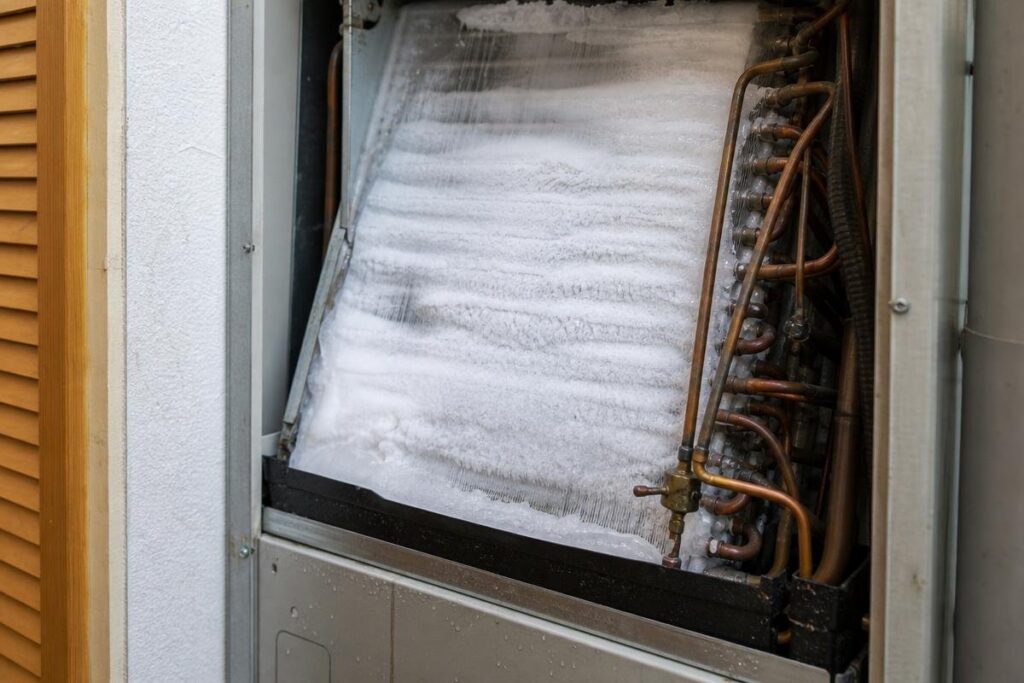
Your AC turning into a block of ice in the middle of summer is one of those problems that catches homeowners off guard. If you’re asking why your AC is freezing up, the answer usually comes down to a handful of fixable causes: low refrigerant, a dirty filter, or restricted airflow through the evaporator coil. In Ventura County, the marine layer adds another wrinkle, since running your AC at a low setpoint during cool coastal mornings can push coil temperatures below freezing faster than most people expect.
Pacific Aire Home Services has served Ventura County families for years, and our technicians diagnose and fix frozen AC systems across Ventura and the surrounding area before small problems turn into expensive repairs. Frozen AC? We can help you figure out what’s going on and get your system running right.
Key Takeaways
- A frozen AC is almost always caused by restricted airflow, low refrigerant, or a dirty evaporator coil.
- Ventura County’s marine layer, which keeps coastal mornings in the 55 to 65°F range well into July, creates conditions where running AC at a low setpoint can freeze coils faster than in inland climates.
- If your AC is freezing up, turn it off and let it thaw completely before restarting to avoid compressor damage.
- A dirty air filter is the most common and easiest fix, so check it first before calling a technician.
- Recurring freeze-ups usually signal a deeper issue that needs a professional inspection to diagnose correctly.
A Frozen AC in the Middle of Summer
You walk over to your AC unit and notice ice forming on the refrigerant lines outside. Inside, the air coming through your vents is barely cool. Your thermostat says 78°F and climbing. A frozen air conditioner in the middle of summer feels like a contradiction, but it happens more often than most homeowners in Camarillo, Thousand Oaks, and Simi Valley expect.
The coastal marine layer along our stretch of Southern California keeps overnight temps cool, then inland heat spikes hit hard when that layer burns off in the afternoon. That back-and-forth puts real stress on your system. Ignoring a frozen AC is not a good idea. It can damage your compressor, which is one of the most expensive parts to replace. We’ll walk through why your AC is freezing up, how to spot it early, what to do right now, and signs the problem may be more serious.
What Actually Happens When an AC Freezes Up?
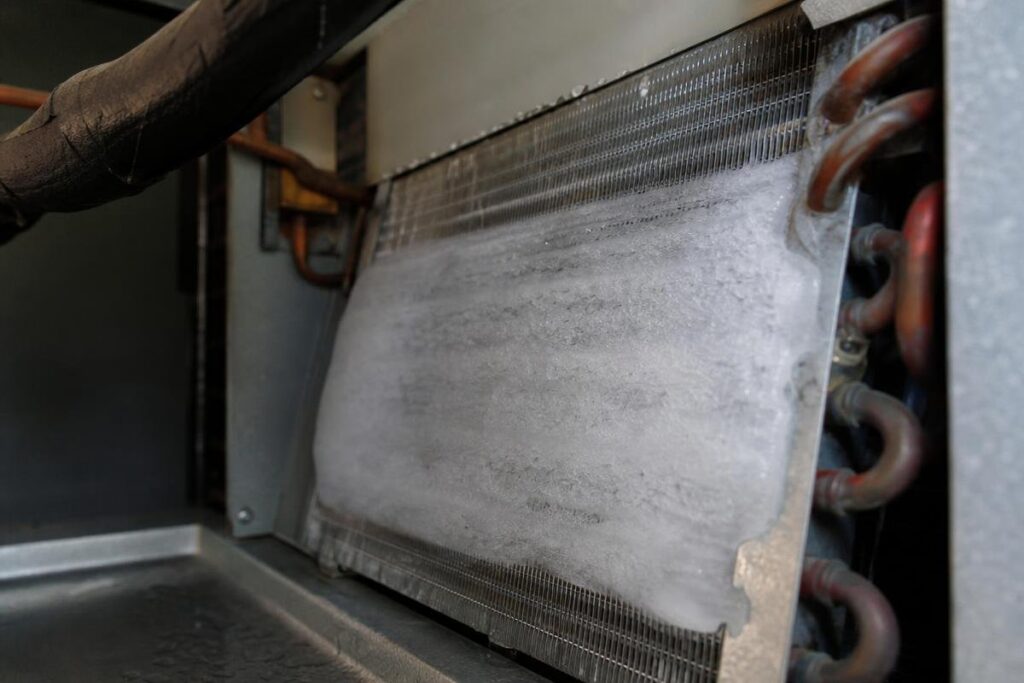
Your AC is not supposed to make ice. When frozen AC coils form inside your system, something has gone wrong with the basic physics your unit depends on to cool your home.
The Evaporator Coil (Inside Your Home)
The evaporator coil sits inside your air handler. Its job is to absorb heat from the warm air your blower pulls across it. Think of it like a cold glass of water sitting out on a humid day. Moisture in the air naturally condenses on that cold surface.
Now imagine wrapping that glass in a blanket. Airflow stops. The coil keeps getting colder. Moisture has nowhere to go, and it freezes right on the coil surface. Ice builds up, blocks airflow even more, and the problem compounds fast. Picture a June morning when the marine layer holds the outdoor temperature at 62°F and your thermostat is still set to 68°F from yesterday’s heat: the coil runs long and cold with very little heat to absorb, and it can tip below freezing.
An evaporator coil frozen solid cannot absorb heat at all, so your AC just blows warm air or nothing. Our AC system maintenance guide explains why catching this early matters, especially in humid coastal air where ice forms faster on a restricted coil.
The Condenser Coil (Outside Your Home)
The condenser coil lives in your outdoor unit. It releases the heat your system pulled from inside. If that coil gets dirty or airflow around it gets blocked, heat cannot escape. Refrigerant pressure builds. The system can ice up from the inside out, even on a warm day.
Both coils can freeze, but the cause differs depending on which one is affected. Knowing the difference helps you describe the problem accurately when you call for service.
How Do You Know If Your AC Coils Are Frozen?
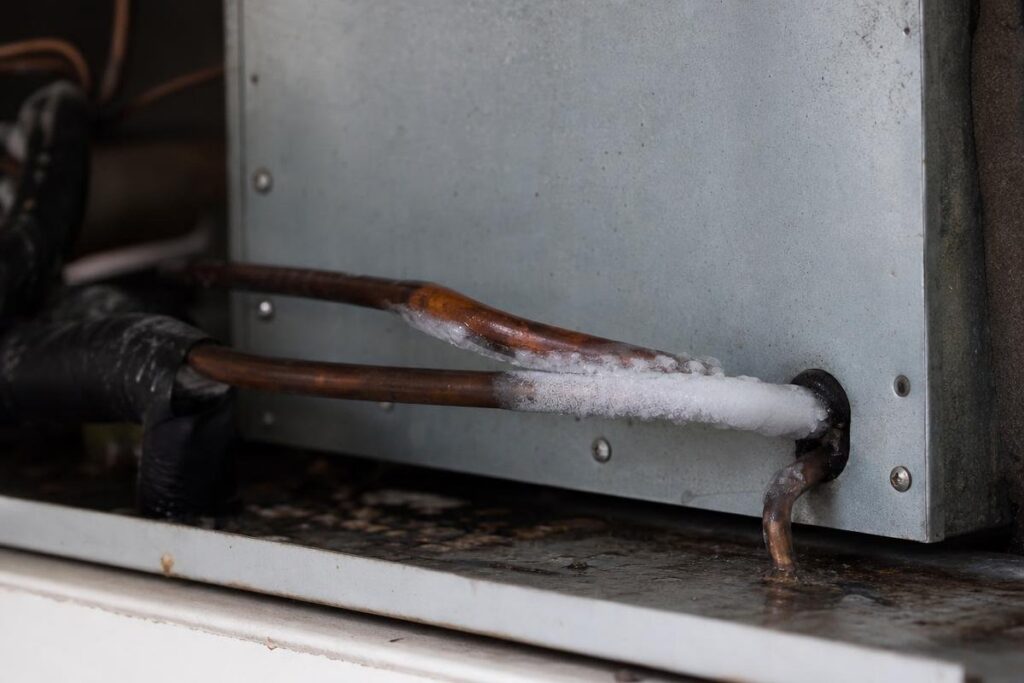
Your system might be running constantly but barely cooling your home. That’s one of the first clues that frozen AC coils are the problem, not just a weak system. Knowing what to look for inside and outside your home can help you catch this early before it turns into a bigger repair.
Indoor Warning Signs
Check these signs first. If you spot more than one, your evaporator coil is likely frozen.
- Warm air blowing from vents even though the system is running
- Visible ice or frost on the refrigerant line near your indoor air handler
- Water pooling or dripping around the base of the indoor unit
- A musty or damp smell from your vents, which in humid coastal neighborhoods can be stronger than usual and is sometimes mistaken for mold
If you see any of these, switch your thermostat to fan-only mode right now to start thawing the coil. For a broader look at what these symptoms could mean, read through these signs your AC system may be broken.
Outdoor Warning Signs
Walk outside and look at your outdoor unit. These are the signs that confirm a freeze is happening.
- Ice on the copper refrigerant lines running into or out of the outdoor unit
- Ice forming on the outdoor unit itself
- The system short-cycling, meaning it kicks on and off more than normal
- Hissing or bubbling sounds near the refrigerant lines
If your AC is not cooling and you see ice outside, shut the system off completely. Running it while frozen can burn out the compressor. Not sure whether your coil is frozen or just failing? Schedule a diagnostic visit and we’ll pinpoint the cause before summer peaks.
The Most Common Reasons Your AC Is Freezing Up
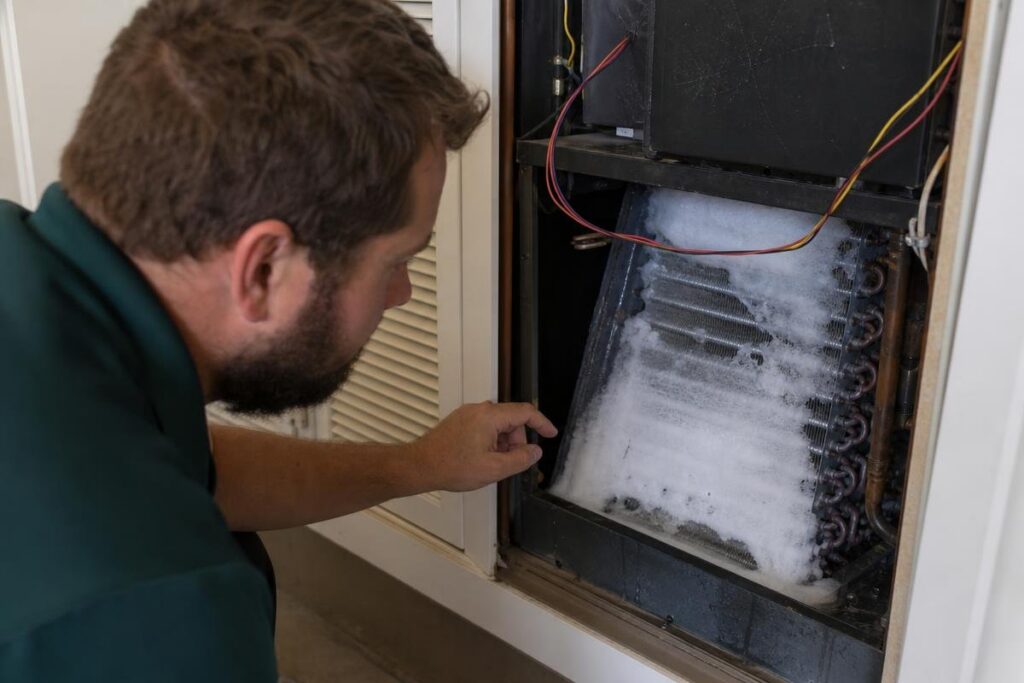
If you’re asking why your AC is freezing up, the answer almost always comes down to one of five causes. Some you can check yourself right now. Others need a technician. Here’s what to look for.
Restricted Airflow
A clogged air filter is the number-one cause of a frozen AC. When the filter is choked with dust, warm air from your home cannot reach the evaporator coil. The coil gets too cold, moisture in the air freezes on it, and you end up with a block of ice.
Pull your filter out and hold it up to a light. If you can’t see light through it, that’s your problem. Also walk through your home and make sure every supply and return vent is open and unobstructed by furniture or rugs. Homes in Camarillo and Thousand Oaks with older ductwork can have restricted airflow even with a clean filter, so if the issue keeps coming back, it’s worth having a technician check your duct system as part of a full summer AC maintenance visit.
Low Refrigerant
Refrigerant is not fuel. Your system doesn’t burn through it. If the level is low, there’s a leak somewhere. Low refrigerant drops the pressure inside the evaporator coil below the freezing point of the moisture in the air around it, and ice forms fast.
Signs include a hissing sound near the refrigerant lines, ice forming on the copper lines outside, and a system that runs constantly but never cools the house down. You cannot check or add refrigerant yourself, and California requires EPA-certified technicians to handle it. This one always requires a licensed professional.
Dirty Evaporator Coil
Even with a clean filter, dust and debris coat the evaporator coil over time. A coated coil can’t absorb heat efficiently. The refrigerant inside stays too cold, and the coil freezes. This is one of the main reasons your AC can freeze up even when the filter looks fine.
Annual professional cleaning is the fix. If you want to stay ahead of this, our Elite Club Membership maintenance plan keeps your coil clean and your system inspected before problems like this develop. Coastal humidity accelerates coil buildup compared to drier inland cities, so skipping annual service carries more risk here.
Running the AC When Outdoor Temps Are Too Low
Most AC systems are not designed to run efficiently when outdoor temperatures drop below 60°F. At that point, refrigerant pressure falls too low, and the evaporator coil freezes. This is a real issue along the coast, where the marine layer keeps overnight temperatures in the 55 to 65°F range well into July.
If you’re running the AC at a low thermostat setpoint on a cool Simi Valley or Santa Barbara evening and wake up to a frozen unit, this is likely why. The fix is simple: raise your thermostat setpoint on cool nights or switch the system to fan-only mode.
Malfunctioning Blower Fan
The blower fan pushes warm air across the evaporator coil. If the motor is failing or the fan belt is worn, airflow drops even when the filter is perfectly clean. The coil gets too cold and freezes, just like it would with a clogged filter.
Signs include weak airflow from the vents despite a clean filter, or unusual humming and grinding sounds coming from the air handler. This is not a DIY repair. If you notice those sounds, shut the system down and call a technician before the problem gets worse. You can also review other signs your AC system may be struggling to help narrow down what’s going on.
What To Do Right Now If Your AC Is Frozen
Found ice on your AC? Stop. Do not just crank the thermostat down and hope for the best. Follow these four steps in order and you can avoid turning a minor freeze-up into a costly compressor repair.
Step 1: Switch Off Cooling Mode
Turn your thermostat to fan-only mode or shut the system off entirely. Do not restart in cooling mode while ice is still present. Running the compressor with a frozen evaporator coil can flood liquid refrigerant back into the compressor and destroy it. That repair is far more expensive than whatever caused the freeze in the first place.
Step 2: Let the Ice Thaw Naturally
Depending on how much ice built up, thawing takes one to three hours. Lay towels around the base of your air handler to catch drip water. Do not use a hair dryer or heat gun to speed things up. Let it melt on its own.
While you wait, use ceiling fans and close the blinds on any south-facing windows. In inland pockets like Moorpark and Thousand Oaks, summer afternoons heat up fast once the marine layer burns off, so keeping direct sun out helps the house stay tolerable while your system is down.
Step 3: Check the Filter and Vents
While the coil thaws, pull your air filter and look at it. If it is gray and clogged, replace it before you restart. Then walk through the house and make sure every supply and return vent is fully open. Closed vents restrict airflow and are one of the most common reasons a frozen air conditioner fix does not hold.
Step 4: Restart and Monitor
Once the ice is gone, switch back to cooling mode and watch the system for 30 to 60 minutes. If it starts freezing again, a dirty filter was not the only problem. At that point, you need a technician. If your AC is also not cooling after the restart, check out our article on why your AC unit is not turning on for more diagnostic steps.
If the problem keeps coming back, our team can diagnose the root cause and get your system running right before the next heat spike hits. AC frozen and the house is heating up fast? Call us at (805) 919-8767 and we will get a technician out to you.
When Should You Repair vs. Replace a Frozen AC?
A frozen AC doesn’t automatically mean you need a new system. But it doesn’t always mean a quick fix will do the job either. Here’s a practical framework to help you decide.
Signs Repair Is Worth It
Repair makes sense in most cases when your system is under 10 years old. If the freeze was caused by a dirty filter, dirty evaporator coil, or a single small refrigerant leak that can be sealed and recharged, you’re likely looking at a straightforward fix. The general rule of thumb: if the repair estimate is less than half the cost of a new system, repair is the smarter move.
Systems in the Santa Barbara and Malibu areas often have longer useful lives because the mild climate means fewer total run hours per year. That’s a real factor worth considering before you decide.
Signs It May Be Time for a New System
If your system is 12 to 15 years old or older, repeated freeze-thaw cycles may have damaged the compressor. Compressor damage is expensive and often tips the math toward replacement. Other red flags include recurring refrigerant leaks or a system that still runs on R-22, a refrigerant that’s been phased out and is costly to recharge.
Salt air near the water can also accelerate evaporator coil corrosion over time, reducing heat transfer efficiency even after a repair. If frozen AC coils keep coming back after service, that pattern matters.
If you’re weighing your options, our full guide on whether to repair or replace your HVAC system walks through the numbers in more detail.
How Ventura’s Climate Makes AC Freezing More Likely
Most homeowners assume AC freezing up in summer only happens during a heat wave. But here in Ventura County, the local climate creates freeze conditions that catch people off guard all season long.
June Gloom is a real factor. The marine layer keeps overnight and early morning temperatures in the 55 to 65°F range well into July, with coastal humidity often sitting high in those early hours. If your thermostat is still set to 70°F or lower from the previous hot afternoon, your system runs through those cool hours with the evaporator coil dropping below freezing.
That is a textbook freeze scenario. A programmable or smart thermostat that raises the setpoint on cool nights can prevent this. Our summer AC maintenance guide covers thermostat settings and other habits that protect your system through the full season.
Then the marine layer breaks. When temperatures in the inland Simi Valley and Moorpark corridor push into the upper 80s and 90s, homeowners crank the AC down to 68°F or lower and leave it there. Running at maximum capacity for hours straight stresses the evaporator coil and loads up the filter fast. That combination is one of the most common reasons we see AC freezing up in summer across the county.
Salt air and marine-layer humidity add another layer of risk. That moisture accelerates corrosion on evaporator coil fins, which reduces heat transfer efficiency over time and makes icing more likely. Homes in Midtown and the Pierpont area face this plus an airflow problem. Older ductwork in those established neighborhoods collects years of dust, restricting airflow in ways that compound every other freeze risk. Keeping ducts clean matters more than most homeowners realize.
How To Prevent Your AC From Freezing Up Again
A frozen air conditioner fix is only half the job. The other half is making sure it doesn’t happen again. Most freeze-ups are preventable with a few simple habits and one annual service visit.
DIY Tasks You Can Do Today
These are the basics that keep airflow and drainage working the way they should.
- Replace your air filter every 1 to 3 months. If you live within a few miles of the beach in areas like Pierpont or Midtown, check it monthly.
- Keep every supply and return vent open and unblocked. Furniture, rugs, and closed doors all restrict airflow.
- Clear a 2-foot radius around your outdoor unit so the condenser coil can breathe.
- Set your thermostat no lower than 68°F during normal operation.
- On cool nights below 65°F, raise the setpoint to 72°F or switch to fan-only mode. June Gloom temperatures in the mid-50s are a common reason why is my AC freezing up becomes a morning-after question.
- Check your condensate drain line once a year for clogs.
What a Professional Tune-Up Covers
A professional tune-up goes where DIY stops. A trained technician will clean both the evaporator coil and condenser coil, check refrigerant levels, inspect the blower motor, tighten electrical connections, and calibrate the thermostat. These are the exact failure points that cause freezing. For summer AC maintenance, annual service is the foundation.
If you live near the water in Santa Barbara or the Malibu corridor, salt air makes annual condenser coil cleaning non-negotiable, not optional. Corrosion builds faster than most homeowners expect.
Our Elite Club Membership keeps you on a regular maintenance schedule without having to remember to book it. Staying on top of these tasks is the simplest way to avoid a frozen coil call in the middle of a heat wave. See how our HVAC maintenance plan works and get ahead of the next one.
Get a free system inspection before summer peaks and keep your coils from icing over when you need cooling most.
Frequently Asked Questions
My filter is clean but my AC is still freezing. What else could cause it?
A clean filter rules out the most common cause, but your system can still develop frozen AC coils for other reasons. Low refrigerant, a dirty evaporator coil surface, or a failing blower motor can all restrict heat transfer enough to cause freezing. A technician needs to check refrigerant pressure and inspect the blower before you keep restarting the system.
Can I run my AC while the coil is frozen?
No. Running the compressor with a frozen evaporator coil forces it to work against restricted airflow. That can cause liquid refrigerant to flood back into the compressor and destroy it. Switch to fan-only mode or turn the system off completely until the ice is fully melted.
How long does it take a frozen AC coil to thaw?
Most coils thaw within 1 to 3 hours in fan-only mode. Heavy ice buildup on both indoor and outdoor components can take up to 24 hours. Place towels around the air handler and check the condensate drain pan so it does not overflow onto the floor.
Does a home warranty cover a frozen AC?
It depends on the policy and the cause. Most home warranties cover mechanical failures like a blower motor or refrigerant leak repair. They typically exclude damage from skipped maintenance, such as a coil clogged from months of dirty filters. Keep records of your filter changes and annual service visits.
How often should I have my AC serviced in this area?
Once per year, ideally in spring before the cooling season starts. The marine-layer humidity along the Southern California coast accelerates evaporator coil fin corrosion faster than you would see in drier inland markets. Annual service catches that early. Our Elite Club Maintenance Plan is built specifically for this kind of preventive care and is the most cost-effective way to stay ahead of freeze-ups.
Does low refrigerant mean I just need a top-off?
No. Refrigerant operates in a closed loop and does not get used up on its own. A low level means there is a leak somewhere in the system. Adding refrigerant without finding and fixing the leak is a temporary fix at best. A licensed technician will pressure-test the system to locate the leak before recharging it.
If your AC has frozen once, it will freeze again unless you find the root cause. Our technicians serve the greater Southern California area including Santa Barbara, Malibu, Moorpark, and surrounding communities. Call Pacific Aire Home Services at (805) 919-8767. We can diagnose the problem, clean the coils, check refrigerant levels, and get your home comfortable before the next heat wave hits.
You can also visit our office at 301 Todd Ct in Oxnard. If you want to read more about keeping your system running well all season, check out our summer AC maintenance tips every homeowner should follow.
Ready to Get Started with Pacific Aire Home Services?
Call (805) 919-8767 to speak with our team directly. We’re ready to answer your questions, walk you through your options, and help you find the right solution for your needs. Whether you’re just starting to plan or ready to move forward, we’ll make the process simple and stress-free.
Reach out today and let’s talk about how we can help.